



PDF & document extraction for AI
Parse, extract, and structure, and contextualize data from invoices, contracts, forms, reports, tables, and complex business documents so your teams and AI agents get full business context.

Emails

Calls

Documents

Messages

Testimonials

Notes

Surveys

Agent logs
Flexor transforms enterprise unstructured data like emails, PDFs, calls and chats into clean, unified, contextualized, AI-ready data with ACE (AI Context Engine), ensuring that every AI system operates on the data that’s relevant to your business.
THE PROBLEM
When business data lives in documents, your AI operates blind
Most critical business information still lives inside PDFs, scanned files, contracts, invoices, spreadsheets, and documents never designed for AI consumption. The result is partial, incomplete and hallucinatory outputs. Traditional OCR and IDP tools often struggle with this.
- Different layouts and changing templates
- Multi-language or messy document formats
- Complex tables and nested data
- Legal clauses, definitions, and business terminology
- Charts, graphs, and visual context
- Missing relationships between extracted fields
The Solution
Flexor transforms raw documents into clean, structured, business-aware context that AI systems can actually use
Intelligent parsing across any format
Every document, regardless of shape
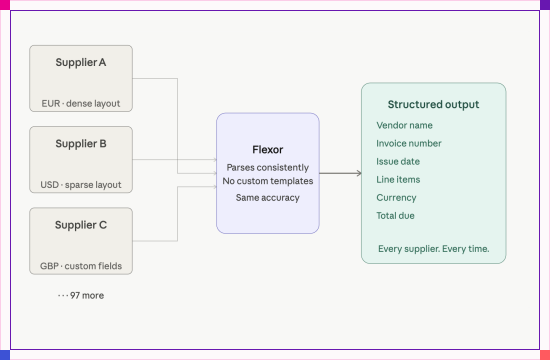
Flexor extracts data from documents regardless of template, layout, or visual structure, adapting automatically to variation across vendors, regions, and internal teams.
For example, invoices from a hundred different suppliers might each use a different layout, currency format, and line-item structure. Flexor parses all of them consistently, pulling the same fields with the same accuracy, without a custom template for each vendor.

AI agents receive structured, reliable data from every document type
Eliminates costly per-template maintenance, manual rework, and exception handling at scale
AI-ready document representation
Documents rebuilt for how models think
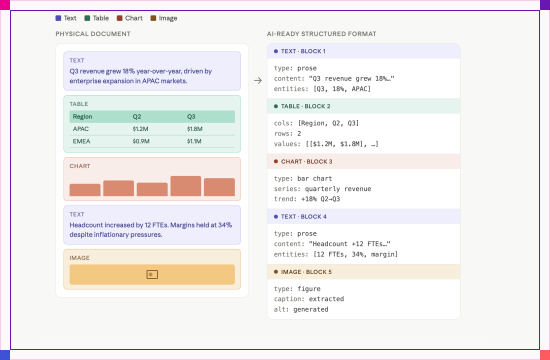
Flexor structures documents into a format most useful for AI to interpret, preserving hierarchy, sections, metadata, and logical relationships, so models receive content that reflects how the document actually works, not a flattened dump of its raw text.
For example, a multi-section product specification with numbered clauses, cross-references, and appendices is reconstructed with all those relationships intact, so an AI agent reasoning over it understands that clause 4.2 modifies clause 3.1, not that they’re two unrelated paragraphs.
Improved accuracy on complex, multi part content
Reduced reprocessing, failed automations, and costly model retries
Complex table understanding
Tables that were never meant to be parsed — parsed
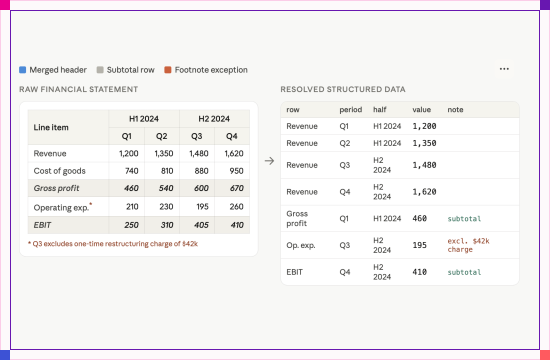
Flexor converts multi-column tables, merged cells, nested structures, and irregular financial tables into clean, structured formats that AI can reliably analyze, regardless of how the original table was designed or how far it strays from a standard grid.
For example, a financial statement merges header cells spanning multiple periods, subtotals embedded mid-table, and footnoted exceptions. Flexor resolves the structure, maps every cell to its correct row and column context, and outputs data an agent can calculate and reason over accurately.
AI agents analyze financial, operational, and regulatory tables with full structural fidelity
Reduced exception handling costs, and downstream errors caused by broken table extraction
Graphs & visual data interpretation
Charts read, not skipped
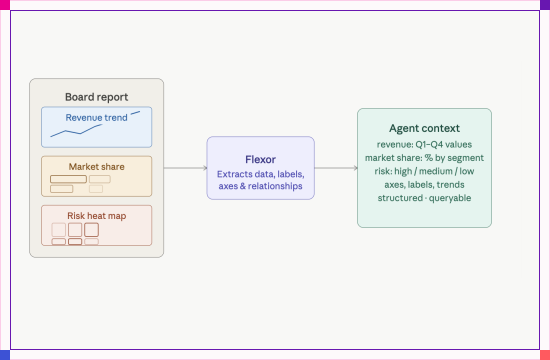
Flexor transforms charts, graphs, and embedded visuals into usable signals and contextual data , so the information encoded in a document’s visual layer is captured alongside its text.
For example, a board report containing a revenue trend chart, a market share breakdown, and a risk heat map carries critical intelligence. Flexor extracts the underlying data, labels, axes, and relationships from each visual, making them available to AI agents as structured context.
Faster decisions and more complete insights from reports, dashboards, and executive materials
Eliminates manual chart transcription while reducing downstream analysis time and operational cost
Operational context layering
Documents connected to the business they describe
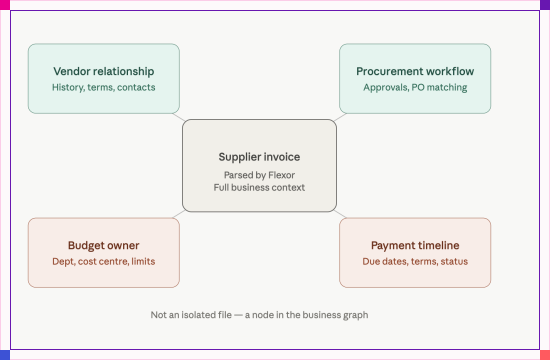
Flexor connects documents to business and data context,, so AI agents understand not just what a document says, but where it sits in the broader organizational picture.
For example, a supplier invoice is connected to a vendor relationship, a procurement workflow, a budget owner, and a payment timeline. Flexor provides the agent with full business context, not an isolated file.
AI agents make better decisions by understanding relationships, dependencies, and business impact
Faster execution across workflows such as approvals, exception handling, procurement, and finance operations
Reduces manual lookups, fragmented system queries, and operational overhead while improving business accuracy
Delivering context for AI
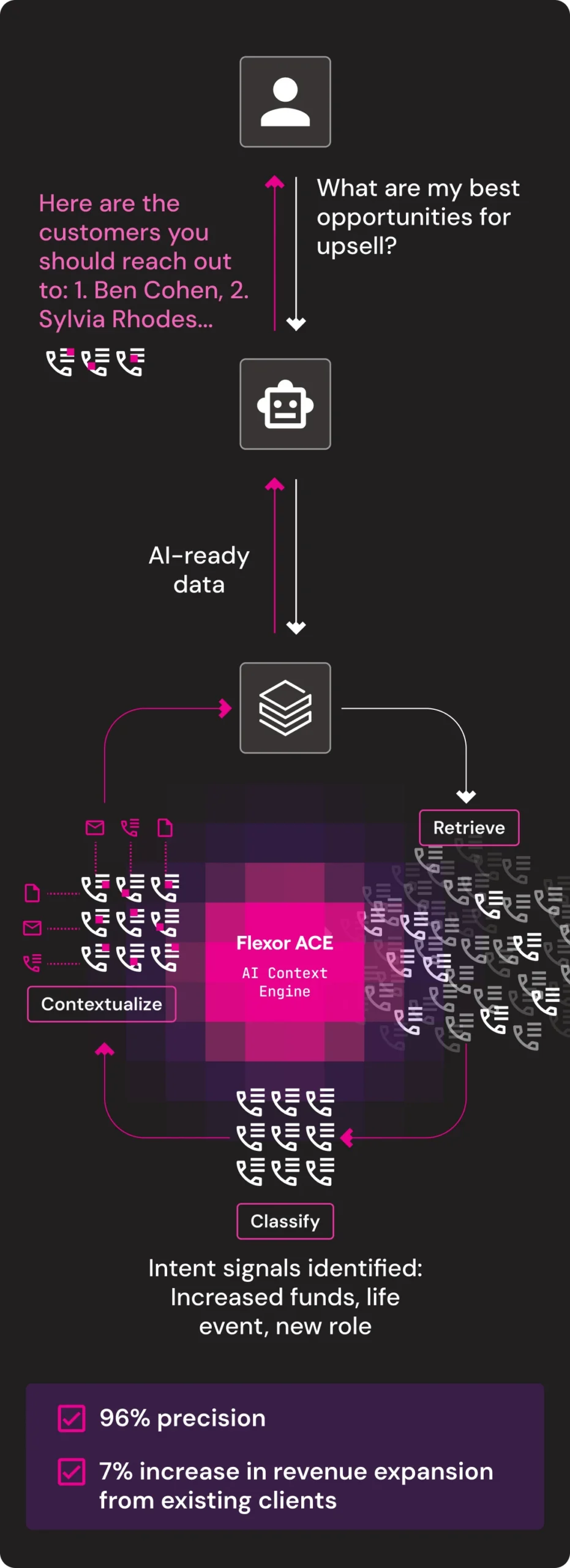
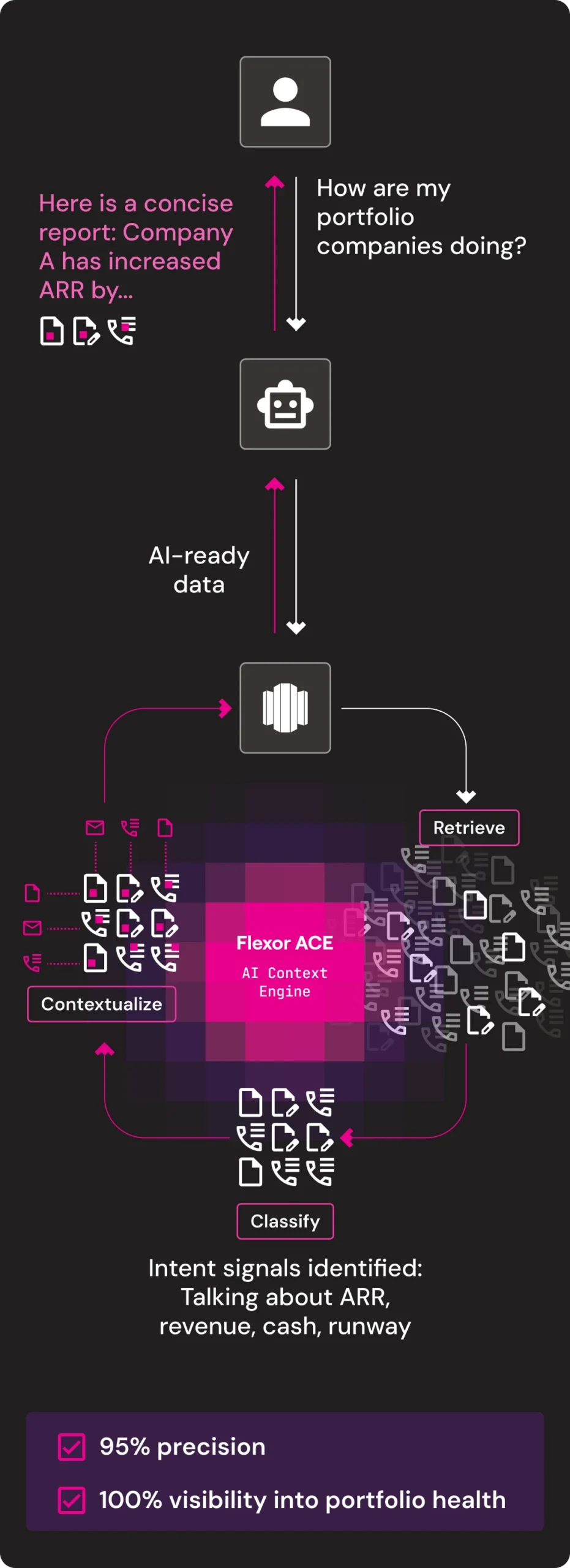
Meet ACE – The AI Context Engine. ACE automates pre-processing and context building with tailored LLMs and VLMs in a robust multi-phase process, giving you everything you need to turn your enterprise unstructured data into context for AI, straight out of the box.
Tackle the toughest challenges holding back your enterprise, today
Here are some of the ways enterprises use Flexor’s AI Context Engine, ACE, across departments.

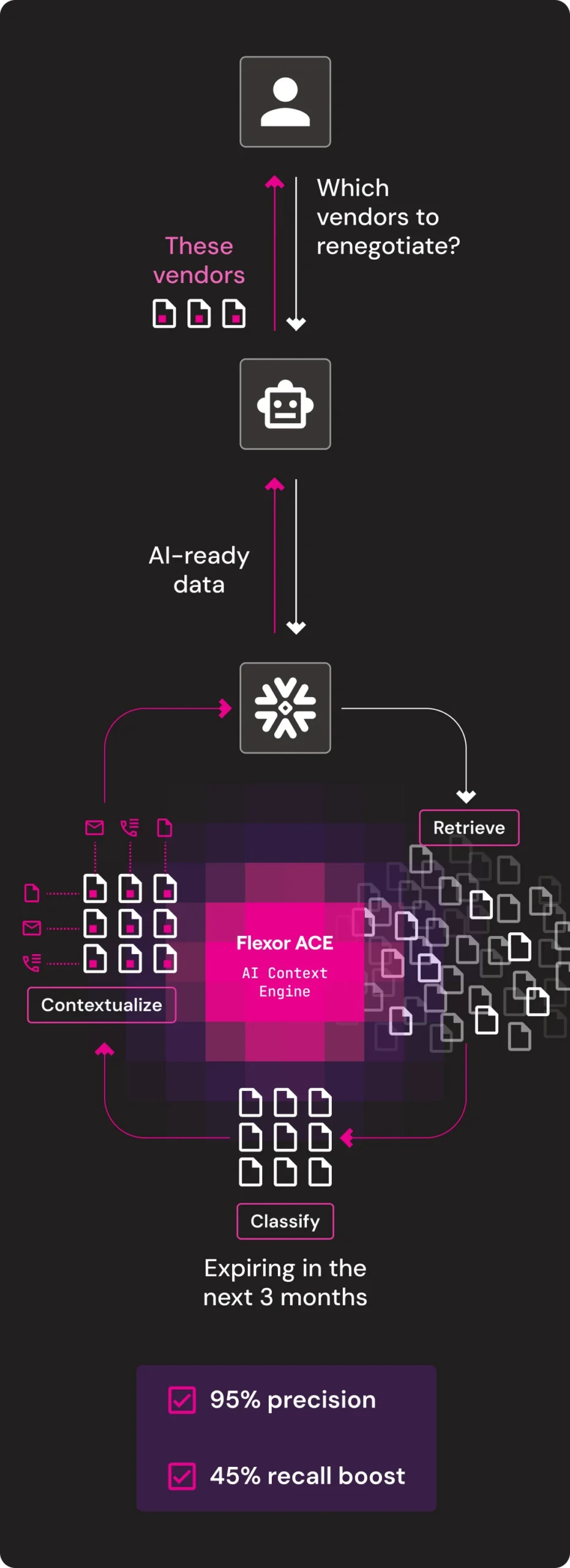
Procurement Optimization

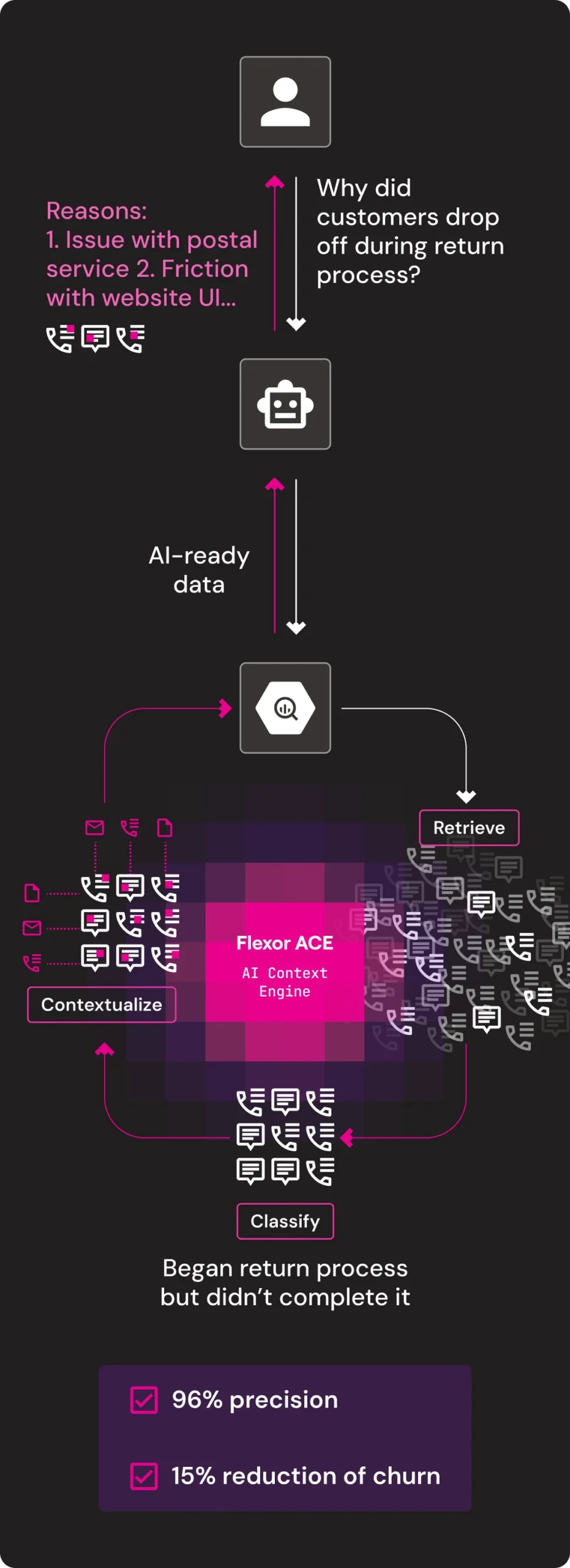
Churn Mitigation

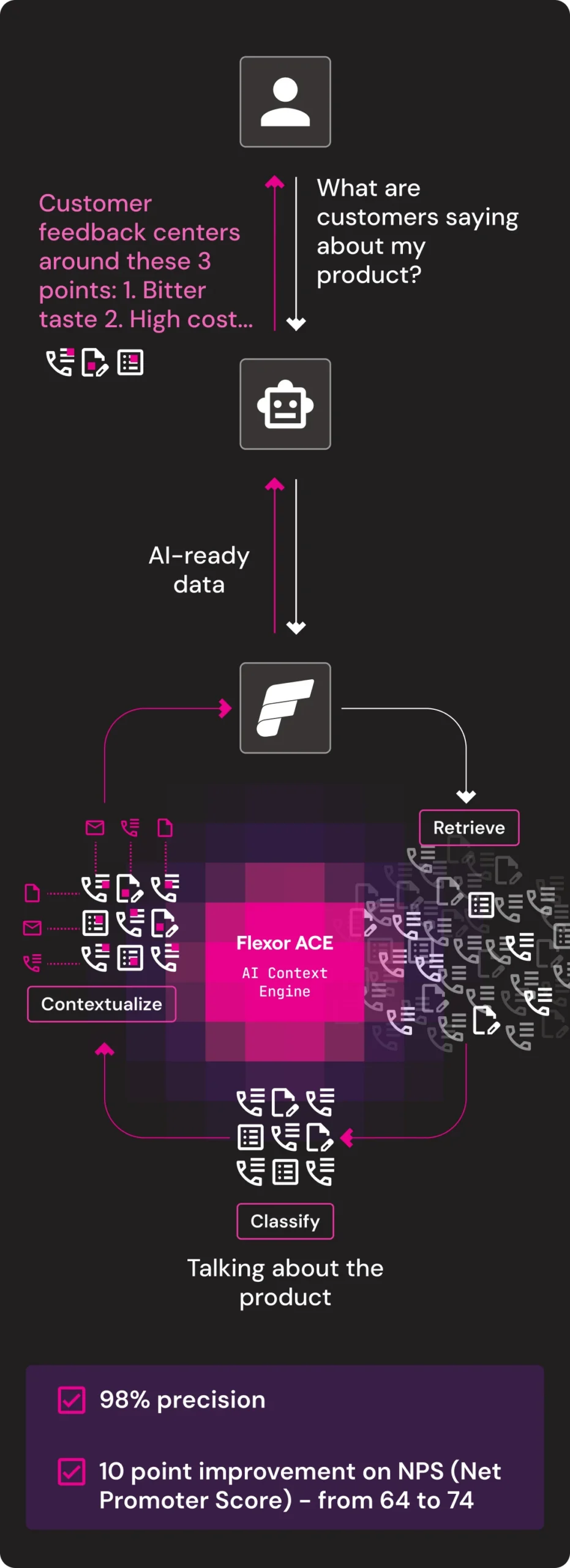
Product Discovery

Upsell Identification

Portfolio Management
Procurement Optimization
Churn Mitigation
Product Discovery
Upsell Identification
Portfolio Management
Ready to give your AI agents the context they actually need?
Transform your unstructured data into a competitive advantage.
Frequently asked questions
What types of documents can Flexor process?

Flexor processes invoices, contracts, forms, board reports, statements, PDFs, scanned files, emails, and other complex business documents in unstructured formats.
Can Flexor handle different templates and layouts?
Yes. Flexor adapts to changing vendor templates, internal formats, languages, and visual layouts without requiring consistent structures across documents or manual template creation for each document type.
How is this different from OCR or traditional IDP tools?
OCR extracts text. Traditional IDP often focuses on predefined fields and structures. Flexor goes further by understanding structure, tables, relationships, visual content, and business context so AI systems can reason on the output.
How does Flexor improve AI performance?
Flexor gives AI systems cleaner, structured, and context-rich inputs, which improves accuracy, reduces hallucinations, and helps agents complete workflows with higher confidence.
Does Flexor connect documents to business context?
Yes. Flexor connects documents to related entities such as vendors, workflows, owners, timelines, business terminology and operational records, so AI understands the broader business meaning of each file.

