


Unstructured context for AI agents
Give AI agents the deep context they need to to truly understand your business and deliver consistently accurate and reliable outcomes.

Emails

Calls

Documents

Messages

Testimonials

Notes

Surveys

Agent logs
Flexor transforms enterprise unstructured data like emails, PDFs, calls and chats into clean, unified, contextualized, AI-ready data with ACE (AI Context Engine), ensuring that every AI system operates on the data that’s relevant to your business.
THE PROBLEM
The unstructured data mess holding your AI back
AI agents are only as good as the data they operate on. In most organizations, unstructured data is not AI-ready, and ends up being a liability, not an asset.
- Fragmented across systems and silos
- Duplicated with no canonical source
- Inconsistent across sources and departments
- Missing business context and relationships
- Stale, unmaintained, or incomplete
- Noisy with low signal-to-noise ratio
The Solution
Flexor makes unstructured data AI-ready
Automated data preparation
Clean, deduplicated, normalized inputs
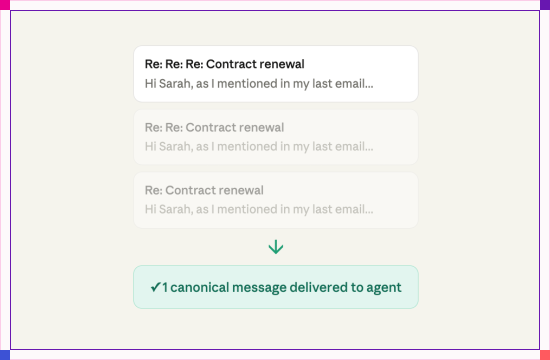
Flexor cleans, deduplicates, translates and parses your unstructured data, to automatically remove the noise that degrades AI output.
For example, email threads repeat the same content dozens of times across threads. Flexor identifies the canonical message, eliminates redundant copies, and delivers a single, clean record to AI agents.

AI agents work with clean, right-sized and reliable inputs to generate accurate, consistent results.
Token costs are reduced by as much as 90%
Continuous curation
Only the most relevant data, always current
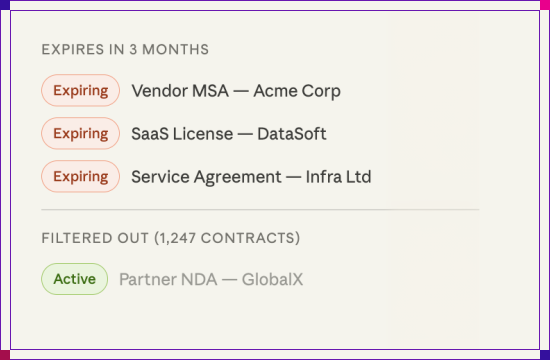
Flexor curates, filters, classifies and parses data continuously, surfacing what matters and suppressing what doesn’t.
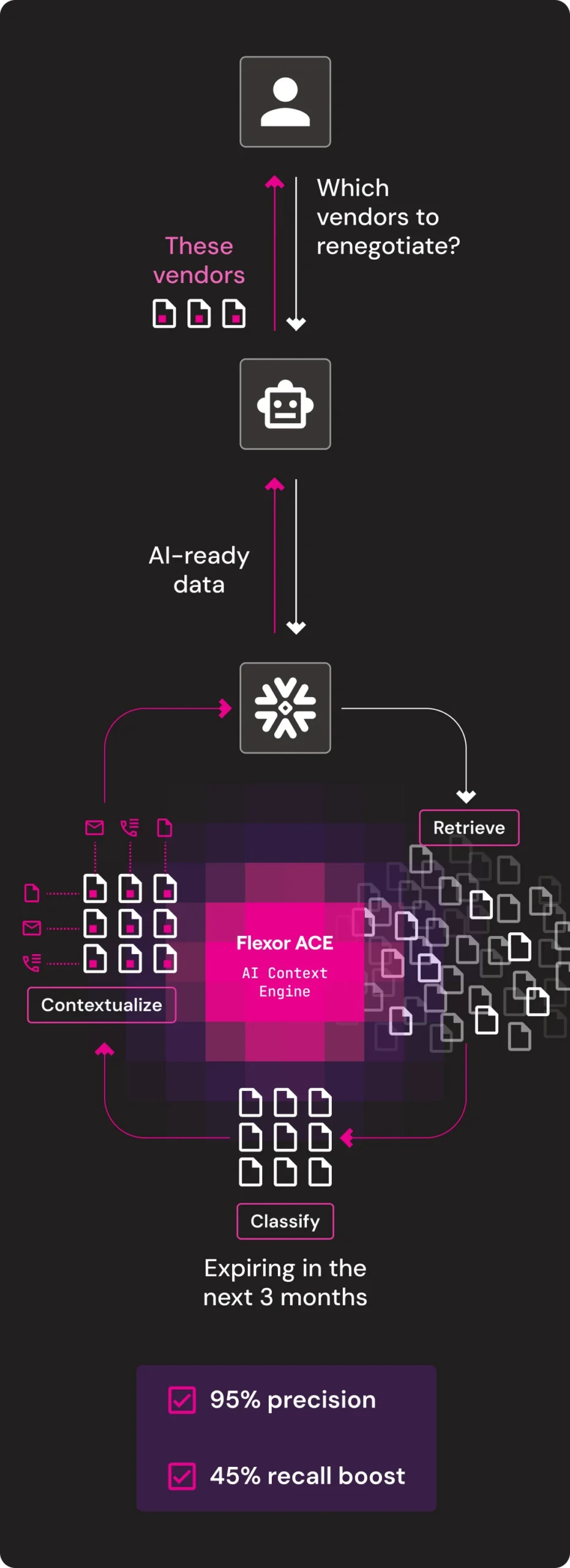
For example, from 1000s of contracts, Flexor ACE identifies and extracts expiry dates, classifies each contract, and surfaces only those expiring within three months. This is delivered in a structured format ready for your AI agent.
AI agents consume only the most relevant, high-quality dataset in a structured format.
Hallucinations and inaccuracies are considerably reduced
Token costs are kept at bay
Unified schema
Standardized once, usable everywhere
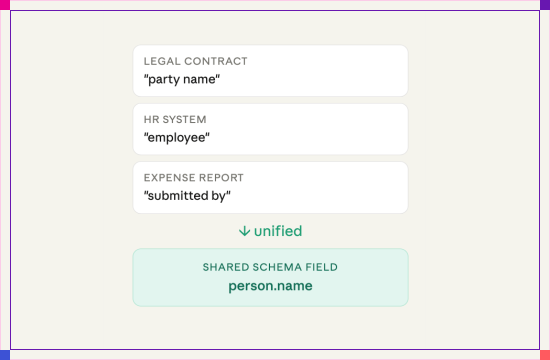
Flexor maps all unstructured data to a shared schema, resolving differences into a single, consistent structure.
For example, “party name” in a contract, “employee” in an HR file, and “submitted by” in an expense report all resolve to the same unified field, so agents can reason across domains without confusion.
AI agents reason across domains through a single, consistent structure, ensuring accuracy across fragmented and conflicting data
No redundant processing and context building or duplicate pipelines across data sources
Full data context
Fragmented data, made whole
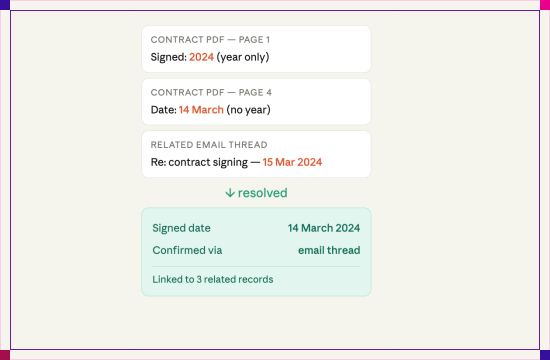
Flexor links relationships across sources, reconstructs fragmented records, and enriches data with missing pieces, so nothing falls through the cracks.
For example, a contract PDF file will display the year on the 1st page and the month and day on the 4th page. Flexor resolves the full date, links it to related correspondence, and surfaces a single coherent record, ready for your agent to act on.
AI agents get a complete, structured view of events, entities, and timelines, eliminating errors across incomplete or disconnected data
Optimized compute and ops spend
Full business context
Domain knowledge, built right in
Flexor maps your organization’s unique terminology, jargon, product naming conventions, and entity relationships, grounding AI agents in how your business actually works.
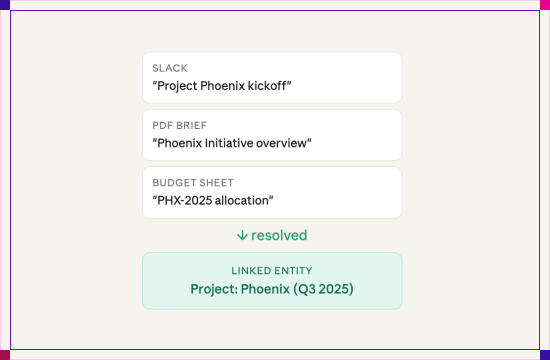
For example, when “Project Phoenix” appears in a Slack message, a PDF brief, and a budget spreadsheet, Flexor knows they all refer to the same initiative and links them into a single coherent record with full context, relationships, and timeline.
AI agents are grounded to reduce hallucinations, increase accuracy, and stay consistent across use cases
Cleaner and faster outcomes
Delivering context for AI
Meet ACE – The AI Context Engine. ACE automates pre-processing and context building with tailored LLMs and VLMs in a robust multi-phase process, giving you everything you need to turn your enterprise unstructured data into context for AI, straight out of the box.
Tackle the toughest challenges holding back your enterprise, today
Here are some of the ways enterprises use Flexor’s AI Context Engine, ACE, across departments.

Procurement Optimization

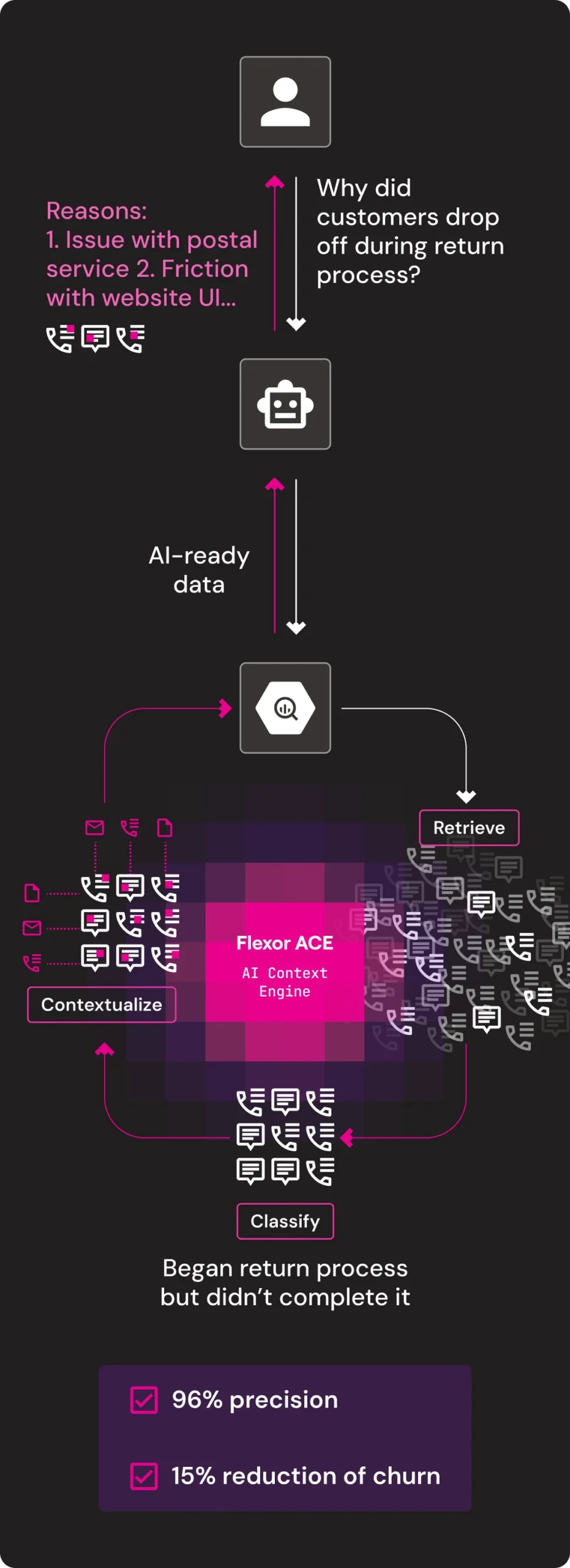
Churn Mitigation

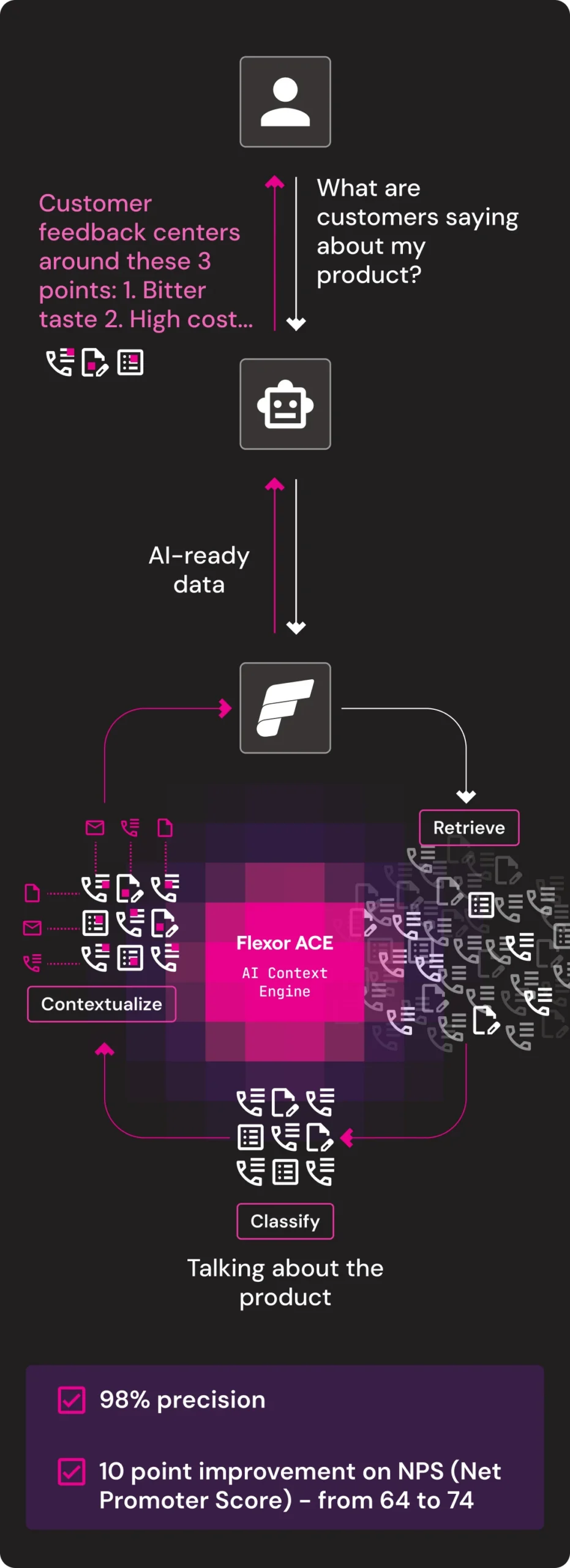
Product Discovery

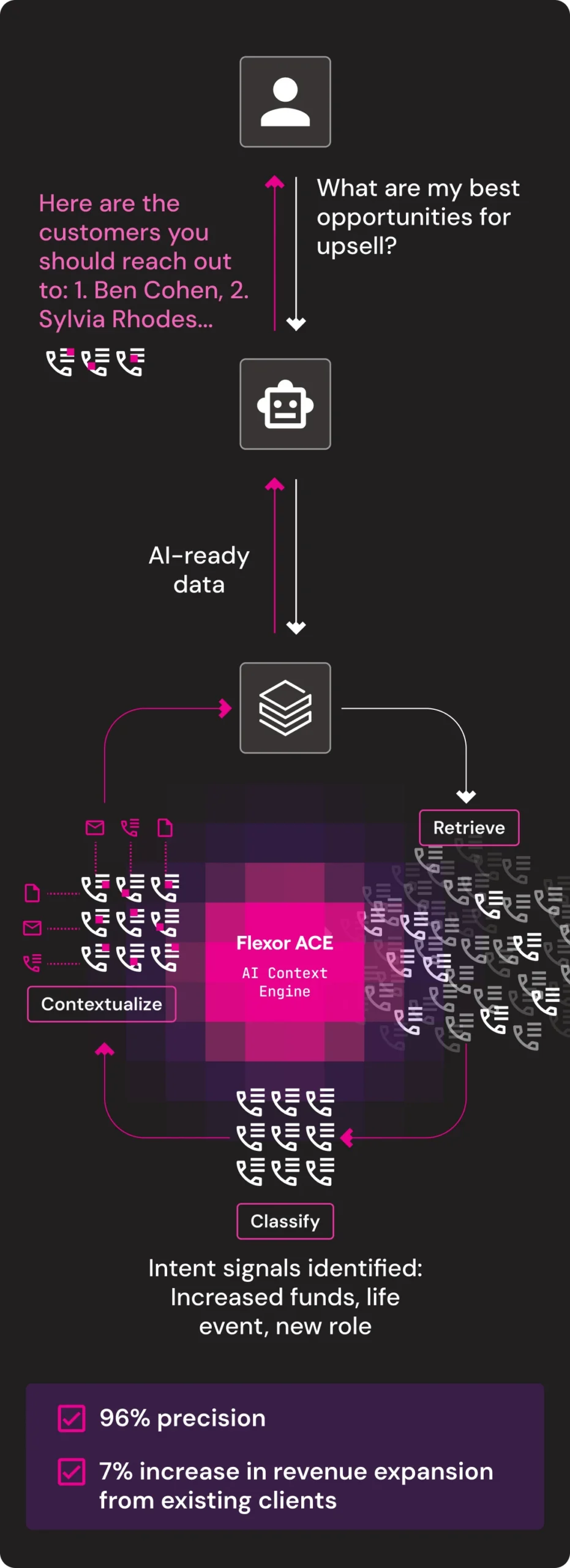
Upsell Identification

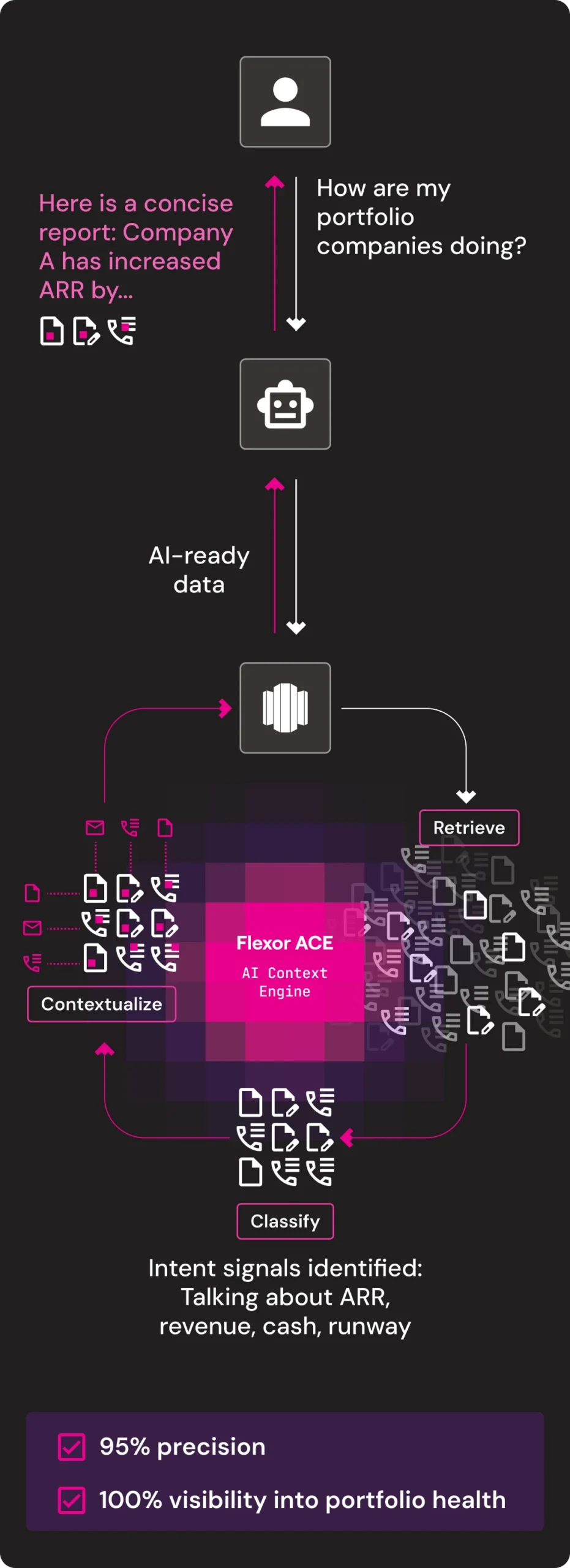
Portfolio Management
Procurement Optimization
Churn Mitigation
Product Discovery
Upsell Identification
Portfolio Management
Ready to give your AI agents the context they actually need?
Transform your unstructured data into a competitive advantage.
Frequently asked questions
Why is unstructured data a challenge in financial services?

Most critical financial knowledge is unstructured: emails, contracts, filings, reports, etc. As data volume grows, teams can’t keep up manually and agents cannot consume it, which leads to missed information, slower decisions and higher risk.
Why can’t traditional tools solve the unstructured data problem?
Traditional tools focus on storage and retrieval, not understanding. They can show you where a document is, but they can’t provide the business and data context that AI agents need to provide complete, accurate and consistent answers
How does unstructured data affect risk and compliance?
Risk signals and compliance obligations are often buried in documents and communications. Without cleaning, structuring, and standardizing the data, issues are detected too late (if at all), increasing the likelihood of regulatory penalties and financial exposure.
What does it mean to make data “AI-ready”?
Making data AI-ready means transforming it into structured, contextualized, and governed inputs that AI systems can reliably use. Without this step, AI outputs are inconsistent, incomplete, or inaccurate.
What problem does Flexor solve for financial services organizations?
Flexor solves the challenge of fragmented, inaccessible knowledge across unstructured data sources like emails, filings, contracts, and research. It turns that data into structured, AI-ready context so teams can make faster, more informed decisions without manual effort.
Can Flexor support regulatory compliance and governance requirements?
Yes. Flexor is built with governance, explainability, lineage tracking, privacy, and security at its core. This ensures every insight is auditable, traceable, and aligned with regulatory expectations.

