




When you deploy a coding agent into a repository, it achieves immediate, high-ROI velocity. It parses codebases, maps dependencies, and pushes correct production updates. This is possible because a software repository is governed by version control: a single, audited, and deterministic source of truth. There is zero ambiguity regarding what is ״runtime.״
But then you task it with driving revenue retention by automatically pitching an account expansion. The agent synthesizes a highly contextual, compliant outreach email… and sends it mere hours after that client’s procurement team flagged a critical billing dispute.
This is the central paradox facing enterprise AI today. The same underlying foundational models yield wildly different outcomes between engineering and business use cases. Solve that and you’ve solved one of the fundamental infrastructure challenges preventing enterprise AI from reaching production scale.
Why AI agents struggle with business data
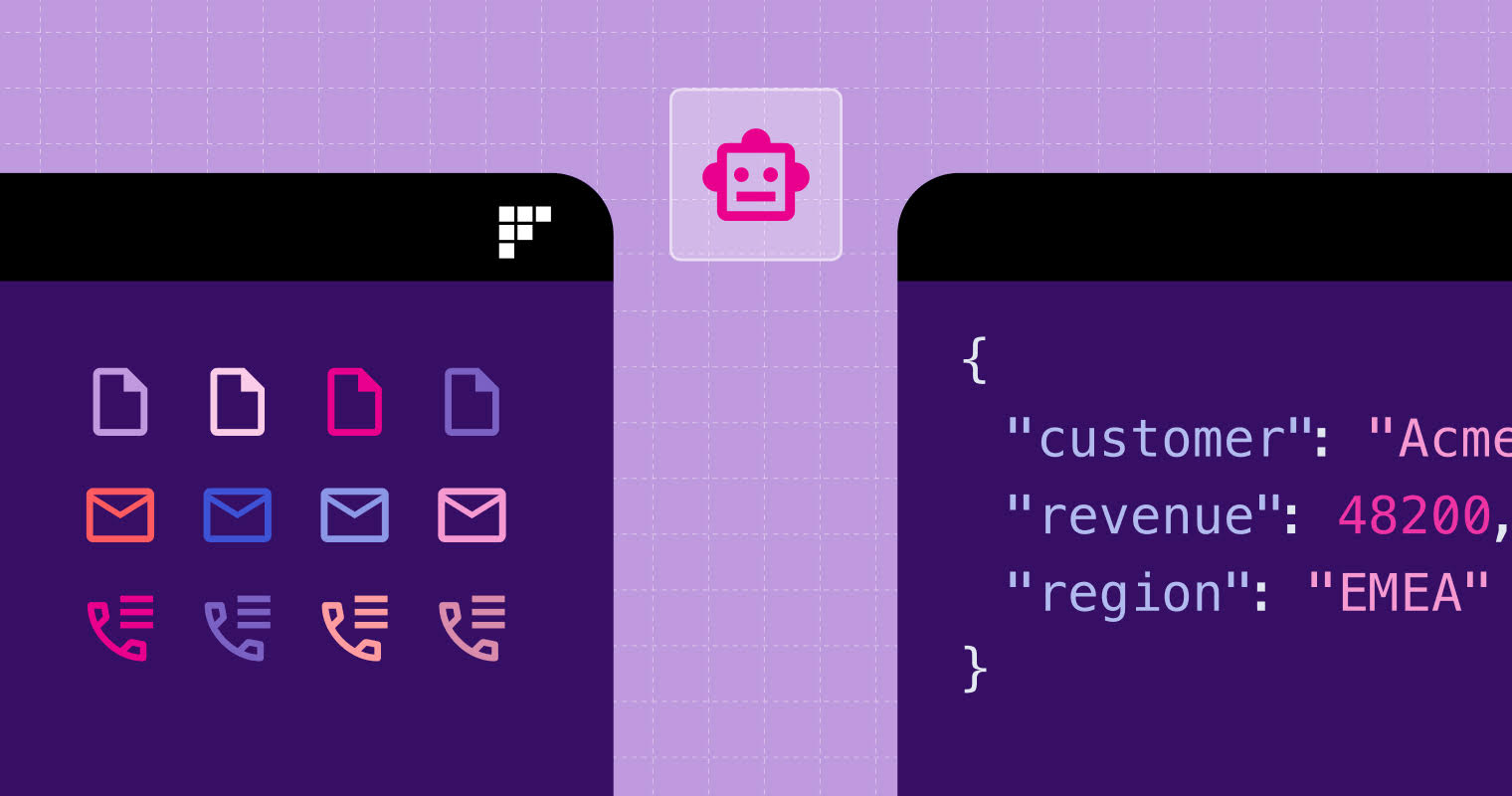
AI agents need more than retrieval, they need an accurate representation of the current state. But business data has no canonical runtime, unlike software repositories. Critical business information generated by multiple users is fragmented across structured data and unstructured data sources. Unstructured data sources include emails, meeting transcripts, Slack conversations, CRM notes, support tickets, contracts, PDFs, and countless other unstructured systems. Each source captures only a partial view of reality, and none reflects the complete operational state on its own.
Our sales agent didn’t suffer a cognitive failure; it suffered a context failure. The critical data required to stop that email lived in siloed systems completely isolated from the agent’s execution layer.
This is fundamentally a data problem rather than a model capability problem. Until unstructured business data can be assembled into a coherent, continuously updated and contextualized representation of the organization, even the most capable reasoning models will continue making decisions that are logically correct yet operationally wrong.
Human employees bridge these systemic gaps through tribal knowledge, manual verification, and institutional memory. And even then, mistakes are plentiful. AI agents do not possess this intuition; they execute with absolute certainty, and create silent operational failures. All while struggling with data that was not curated for machines (unlike code), meaning there’s no way to verify the quality of the output.
This is why pilot programs look flawless in a sandbox but quietly fail or stall out in production. When agents lack a validated organizational state engine, they lose user trust.
Building the business equivalent of a software repository
Enterprise AI requires a source code-equivalent foundation for business knowledge. That foundation must continuously transform fragmented and unstructured information into a coherent representation of organizational state. Doing so requires solving several fundamental data engineering problems.
- Resolving discrepancies – The same business event often appears differently across systems. A customer may be labeled “Enterprise” in CRM, “Strategic” in Slack, and referenced only by project codename inside email. An AI system must determine whether these represent different entities or multiple views of the same one.
- Deduplication – Business information is duplicated constantly. The same meeting notes appear in email, are copied into CRM, summarized in Slack, attached multiple times to tickets, and referenced in documents. Without deduplication, AI repeatedly reasons over identical information, increasing both inconsistency and cost.
- Cleaning and normalization – Most enterprise data was never created for machine consumption. Emails contain signatures, quoted replies, disclaimers, and formatting artifacts. Documents contain tables, scanned images, footnotes, and graphs. Conversation transcripts include interruptions, corrections, and ambiguity. Plus, the majority of information generated is not necessarily business-related and therefore most token use is not information-related, translating to wasted costs and limiting the ability to include relevant information in the context window foe complex tasks. Therefore, before AI can reason effectively, this information must be normalized into machine-readable knowledge.
- Linking related context – Business knowledge rarely exists in isolation. An email references a proposal. The proposal references a contract. The contract references an amendment. The amendment explains why Finance rejected the original pricing. Humans naturally follow these relationships. Machines typically cannot unless those connections have already been established. Context is not a collection of documents. It is the graph connecting them, and the index pointing to how they are connected.
- Understanding domain-specific meaning – Business language is contextual. “P1” means something different inside Engineering than inside Customer Support. “Renewal” means one thing to Sales and another to Finance. Customer names become project names. Internal acronyms evolve. Teams invent terminology that exists nowhere outside the organization. Without domain intelligence, AI retrieves text but misses meaning.
- Respecting organizational boundaries – Not every employee should see every document. Neither should every AI agent. Business context must therefore be curated, ensuring every AI system receives only the information appropriate for its task, role, and permissions.
- Supporting multiple repositories – The same enterprise information has different meaning for different agents and use cases. The data should be processed once and then it once, and then derive to multiple repositories from the same foundation, each tailored to a specific AI agent, domain, or workflow.
The solution: An AI Context Engine (ACE)
An AI Context Engine provides the missing infrastructure layer between enterprise data platforms or lakes, and AI agents. Instead of exposing agents directly to messy unstructured enterprise sources, ACE continuously prepares and contextualizes business knowledge into a unified, consistent and trustworthy representation of business reality.
Remember our sales agent?
With an AI Context Engine in place, the agent doesn’t search for “upsell signals.” It queries a unified business representation, for example, all customer-facing activity for Customer X. Because customer identities have already been resolved and communications from CRM, email, Slack, and support systems linked together, the active billing dispute is immediately available. The agent pauses the upsell email and alerts the account manager instead. Rather than reasoning over disconnected documents, it reasons over the organization’s live operational state.
By decoupling context preparation from agent execution, organizations realize measurable improvements across four dimensions:
- Higher Operational Accuracy – Agents reason over both complete and curated business context, giving them the information that’s comprehensive yet narrow and relevant to the task at hand. This reduces incorrect decisions caused by missing, conflicting, or extraneous information.
- Agents reason over complete, curated, and reconciled business context, giving them the information that’s both comprehensive and relevant to the task at hand. This reduces incorrect decisions caused by missing, conflicting, or extraneous information.
- Lower Inference Costs: Information is parsed once and reused across workflows and agents reason only over curated, task-relevant context. This reduces token consumption, redundant retrieval, and overall inference costs.
- Deterministic Governance – Organizations expose curated context boundaries tailored to specific use cases, people, departments, and groups, ensuring strict compliance and security.
- Systemic Consistency – Every agent, application, and department operates from the exact same context layer, representing the organizational truth.
Just as version control became the foundational infrastructure that made modern software engineering possible, enterprise AI requires an equivalent infrastructure layer for business knowledge and data. Without it, increasingly capable models will continue to make decisions that are logically flawless, yet operationally disastrous.