

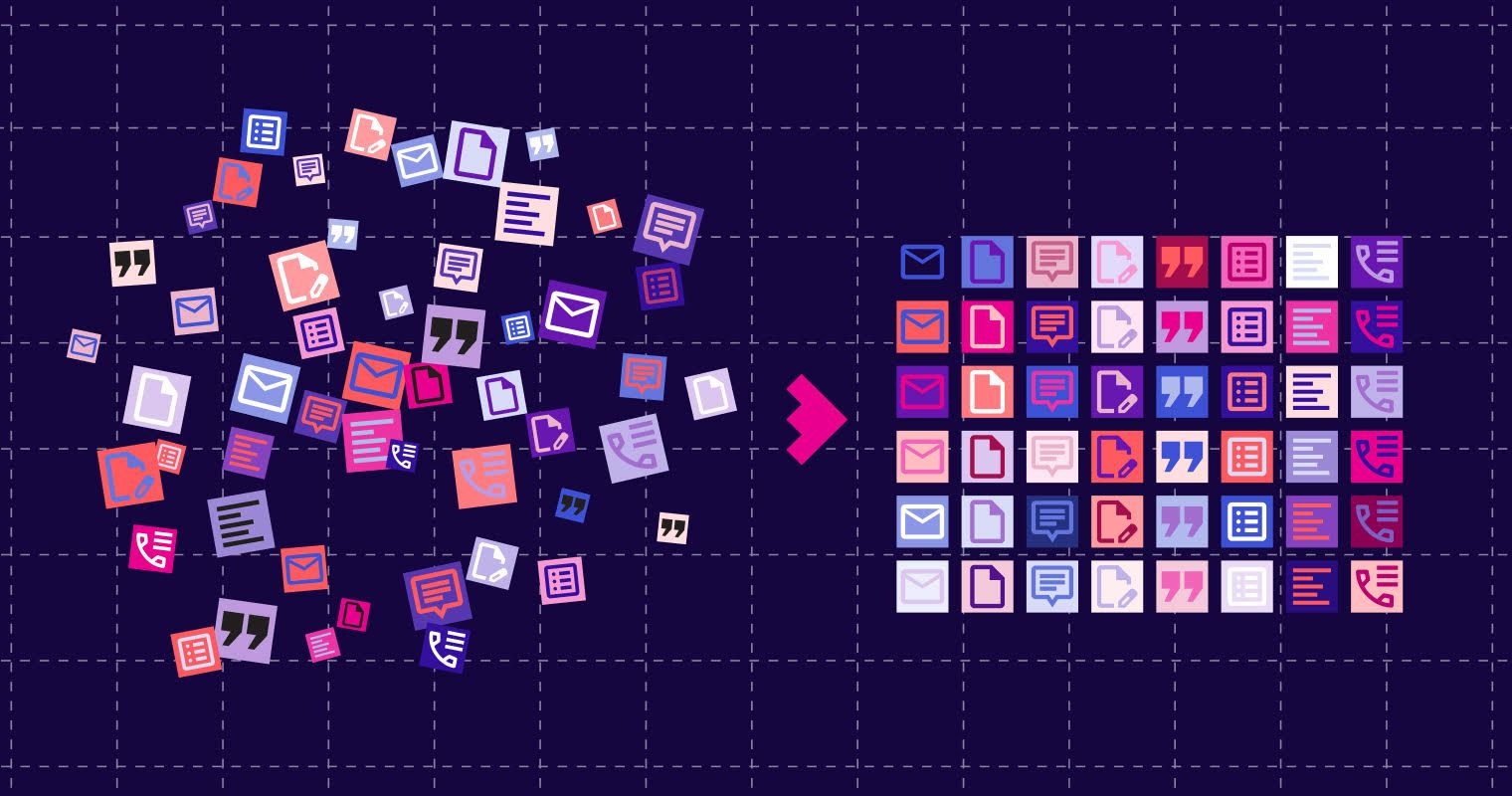


An AI agent receives a customer question. The answer exists somewhere across years of calls, emails, contracts, transactions, and support records. But before the agent can respond, it must find the right sources, interpret them, reconcile conflicting information, and reconstruct the customer’s history.
That is where enterprise AI begins to break. The model may be capable, but the context surrounding it is fragmented, unstructured, and unprepared for agentic work.
Why agentic AI requires a new approach to unstructured data
Enterprise agents are expected to do more than retrieve individual facts. They must complete complex workflows, reconcile information across sources, and make decisions based on changing business conditions.
Yet the data they depend on may span decades of history with millions of emails and terabytes of files. It may contain conflicting records, specialized terminology, and relationships that are not explicitly documented. Expecting an AI agent to search and interpret this environment from scratch for every task is like asking someone to answer questions about books from an entire library without first organizing or studying its contents.
Direct access to documents and applications may work for an isolated use case, but it does not hold up across hundreds of workflows and thousands of daily interactions. At call-center scale, for example, that reconstruction work may need to happen thousands of times a day. Even one overlooked email or disconnected record can materially change an answer and damage customer trust.
In addition to inconsistent and inaccurate results, direct agentic access is also a costly effort for the enterprise. When every AI application connects independently to raw enterprise data, each use case rebuilds much of the same pipeline. Different teams may extract the same PDF into JSON several times, re-summarize the same email thread, or independently reconstruct the relationship between a contract and its amendment. The organization pays for that work again every time, in tokens, GPU time, engineering effort, and latency.
More capable agents can compensate by searching repeatedly until they find enough evidence, but this adds round trips: retrieve, check, realize something’s missing, search again, wait for processing to finish. Agent persistence can paper over weak context, but at a high operational cost and still without guaranteeing complete coverage.
Test yourself: Are your agents conducting repetitive data work?
Organizations can measure the hidden data work surrounding AI by asking themselves:
- How many times did your team end up paying multiple times for AI tokens to extract the same PDF?
- How much precious GPU & CPU resources does your team waste, waiting for MCPs to fetch data?
- What percent of your agent’s answers are backed by real data? Do you have AI explainability baked in?
- How many round-trips does your AI make to retrieve information, and how much time and money is this costing you?
The solution: Shared, managed context for AI
Organizations need a shared, managed context foundation that prepares information once, preserves what has been learned about it, and makes that work reusable across models and use cases.
This foundation rests on three principles:
1. Process once, reuse everywhere
Enterprise data should not be re-extracted, cleaned, deduplicated, or transformed for every AI application and user request. Common processing should happen once, and the results should become reusable assets. Deduplicating email threads is a simple example: a long thread can contain many repeated copies of earlier messages. Deduplicating those messages before inference preserves the conversation while reducing the amount of content agents must process.
2. Generate content-based metadata
Traditional metadata, such as a filename, mailbox, author, or creation date, is insufficient for unstructured data. A useful context layer should also identify what the content discusses: products, services, customers, issues, contracts, incidents, and other domain-specific concepts. This makes retrieval more efficient because agents can narrow their search before reading the underlying material.
This also strengthens governance. An email stored in an ordinary employee’s mailbox may contain a forwarded executive discussion or other sensitive information. Access decisions based only on storage location or sender identity will miss that risk. Content-based metadata helps determine what the information actually contains and whether a particular model or user should be permitted to access it.
3. Deep linking based on content and context
When the system discovers that two pieces of information are related, it should preserve that relationship for future use. A contract amendment should be linked to the original agreement. A customer complaint should connect to the relevant product and earlier interactions. An equipment record should link to its manuals, maintenance history, and facility.
These links give agents shortcuts through complex data. They no longer need to rediscover the same relationships during every task. Just as importantly, the links can be inspected and corrected. If a contract is linked to the wrong amendment, a human can repair that relationship once, improving every agent and application that uses it afterward. When intermediate results are discarded, that opportunity for lasting improvement disappears.
The result of implementing these principles is AI that responds faster, uses fewer resources, produces more consistent answers, and can be extended across hundreds of use cases without rebuilding the same context pipeline each time.
The new paradigm: An agentic-first architecture
What does shared context look like in an AI architecture?
Software development and security moved important work earlier into the workflows through practices such as CI/CD and shift-left security. Enterprise AI needs a similar architectural change: context preparation should move upstream, before an agent begins reasoning.
ACE, the AI Context Engine, is an AI infrastructure component that enables shifting left unstructured data preparation and contextualization.
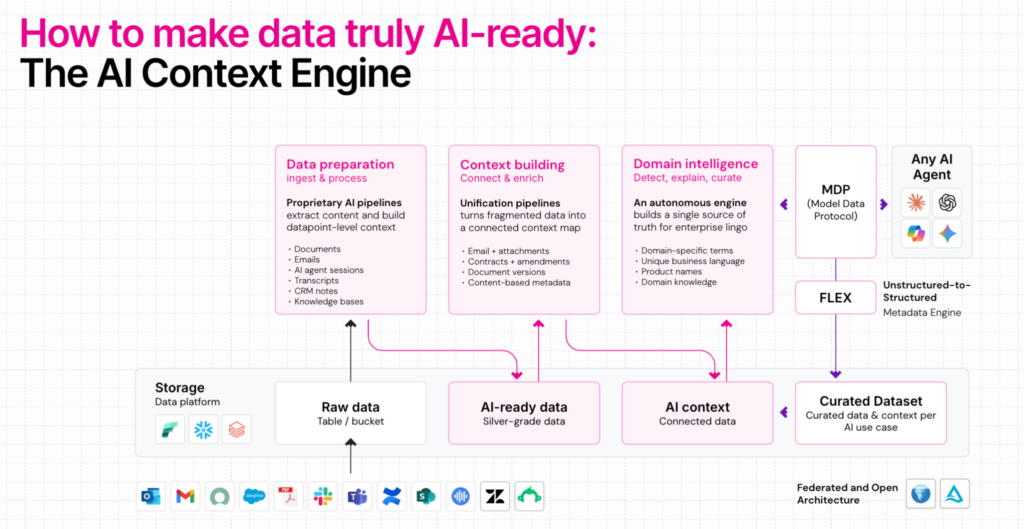
Here’s how the shift left process works with ACE:
Raw data: Documents, emails, calls, messages, and other unstructured data sources are brought into the enterprise data platform.
Data preparation: The raw data is extracted, cleaned, normalized, and deduplicated. The result is AI-ready data.
Context building: The prepared information is then organized into a map of entities and relationships. This map shows how customers, products, communications, contracts, transactions, facilities, equipment, and other concepts relate.
Agents can consult this map instead of wandering through disconnected repositories. Without it, they must spend additional time and compute working out where information is and how the pieces connect.
Agent harness: The harness defines which retrieval techniques to use, how to combine them, and which information sources or categories must be considered.
Domain intelligence: A shared vocabulary and semantic layer establishes common definitions for specialized business language, including acronyms, internal product names, equipment codes, barcodes, subtle distinctions, and important footnotes. Agents can reason from the same domain knowledge instead of independently interpreting the terminology each time.
The data and its surrounding context are then ready for AI agents to reason over and use to support decision-making.
Vanguard’s story: AI context for call centers
What does implementing AI context look like in a real business use case?
If you’ve ever dealt with customer service, you have felt this pain: every new interaction feels like starting over. Calls, emails, and web chats are fragmented and stored in separate systems, and much of their meaning disappears once an interaction ends. When you contact the company again, you have to repeat your history, explain what has already been attempted, and hope the next representative has enough knowledge and system access to help. This creates inconsistent service, unnecessary transfers, longer resolution times, and growing frustration.
Vanguard set out to solve that challenge with AI context.
When a customer calls, AI analyzes interactions in near-real time. It summarizes the call, scores sentiment, saves notes, and presents the complete knowledge graph of the customer. When the customer calls again, the human representative gets all the contextual information, before the customer even says a word. The customer could also be routed to a representative with the right expertise instead of being transferred repeatedly.
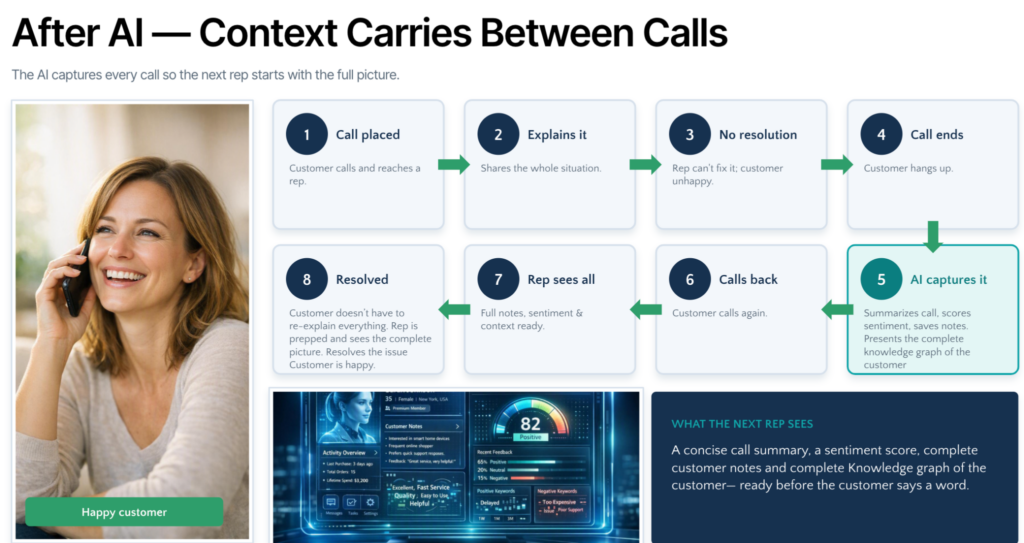
The result is a more informed starting point for every interaction, with the potential to reduce repetition, unnecessary transfers, and resolution time while delivering more consistent service.
The next AI advantage is context
Early AI competition centered on model size, training data, and benchmark performance. Then organizations began debating which model or provider was best. But as enterprise AI moves into production, the question that matters is no longer which model is most capable. It is whether that model has the context required to produce a reliable business result.
That advantage will come from preparing enterprise data once, preserving its meaning and relationships, and making that context reusable across models, agents, and workflows. ACE provides that managed foundation, allowing agents to spend less time reconstructing what the enterprise already knows and more time completing the work they were built to do. See how.